When Your Mind Gives Up Before You Do
Tori Thomas
7/2/20268 min read


A Reframing Practice for Real Time
So here is the reframing practice I’m trying to use in real time:
1. First, name the thought.
Not the polished version. The real one. The one you would rather not admit because it sounds dramatic even to you. “I’m never going to get this right.” “I’m too late.” “I’m not capable.” “God must be disappointed in me.” “I’m not as strong as other people.”
2. Then separate the fact from the story.
The fact might be, “I have started and stopped several times.” The story might be, “That means I will never be consistent.” The fact might be, “This project has not grown the way I hoped.” The story might be, “That means I am invisible and nothing I do matters.”
Facts need attention. Stories need examination.
3. Then ask, “What else could be true?”
This question has been helping me because it does not force me into fake positivity. It does not ask me to say, “Everything is amazing!” when everything, in fact, is acting a little suspicious. It simply asks me to make room for a fuller truth.
What else could be true?
Maybe I am not failing. Maybe I am under-supported.
Maybe I am not incapable. Maybe I am overwhelmed.
Maybe I am not behind. Maybe I am building slowly.
Maybe God is not punishing me. Maybe He is meeting me in a place I keep trying to escape.
Maybe my lack of visible success is not the end of the story. Maybe it is an invitation to look at how I am engaging, what I believe, and what I need to practice next.
4. And finally, choose one small faithful action.
Not a dramatic overhaul. Not a full-life renovation by Friday. Just one action that lines up with the reframe instead of the fear.
If the fear says, “There is no point,” the faithful action might be opening the document for ten minutes.
If the fear says, “You are behind,” the faithful action might be writing down one next step instead of measuring the whole staircase.
If the fear says, “God must be disappointed,” the faithful action might be praying honestly instead of hiding.
If the fear says, “You will never change,” the faithful action might be doing one thing today that your old pattern told you not to do.
Lately, I’ve been thinking about how much of our lives are shaped before we ever take the first step.
Not always by what actually happens.
Sometimes by what we already believe is going to happen.
There is a version of “trying” that looks like effort on the outside, but inside, we have already packed up and gone home. We say we’re going to give something a chance, but somewhere in the back of our mind, a quieter voice is already whispering, “This isn’t going to work. You always do this. You’re going to fail again. Don’t get your hopes up.”
And then we wonder why our effort feels so heavy.
I don’t say that from a place of judgment. I say it because I recognize that voice. I know what it feels like to want to believe differently but have past experience standing there like a very tired security guard saying, “Absolutely not. We have been here before.”
Why “Think Positive” Can Feel Like an Insult
That’s the hard part about mindset work. When you have lived through disappointment, “think positive” can feel insulting. It can sound like someone is asking you to ignore evidence. Because your mind is not just being negative for fun. It is trying to protect you from the pain of hoping and being disappointed again.
But protection and truth are not always the same thing.
Sometimes the thought that feels “realistic” is actually fear wearing sensible shoes. Very convincing shoes, by the way. Practical. Arch support. The whole thing.
I’ve been sitting with this because I don’t want to encourage fake positivity. I don’t want us walking around repeating phrases we don’t actually believe, trying to spiritualize over pain we have not made room to process. But I also don’t want us confusing discouragement with discernment.
Because there is a difference between being honest about what has happened and letting what has happened decide what is still possible.
A Fact Is Not a Prophecy
One mindset trap I fall into is assuming that because something has not worked yet, it means it will never work. That word “yet” matters. It is small, but it creates breathing room. “This has not worked” is a fact. “This will never work” is a prophecy. And sometimes we are not responding to the fact. We are responding to the prophecy we accidentally wrote in our own fear.
Does Struggle Mean I Missed God?
Another trap is believing that struggle means we are doing something wrong. This one can get especially tangled for those of us trying to live by faith. When something does not go the way we hoped, it is easy to wonder, “Did I miss God? Am I not aligned? Am I not disciplined enough? Am I not faithful enough? Is this happening because something is wrong with me?”


That question can become heavy very quickly.
But not succeeding the way we thought we would does not automatically mean we are not right with God.
Sometimes it means we are learning. Sometimes it means the timing is different than we expected. Sometimes it means there are skills we still need to build, support we still need to receive, or patterns we still need to notice. Sometimes it means we are being formed in ways we would not have chosen because, honestly, most of us would choose the express lane of transformation if God gave us the option. Preferably with snacks.
But the absence of the outcome we wanted is not always the absence of God.
Scripture does not show us a life of faith where everyone who is aligned with God gets immediate clarity, instant success, and smooth forward motion. Joseph had a promise and still went through the pit and the prison. David was anointed and still spent years in the in-between. Elijah called down fire and still found himself exhausted, afraid, and asking God hard questions. Even Paul spoke openly about weakness, pressure, and suffering.
The Story You Tell Yourself Matters
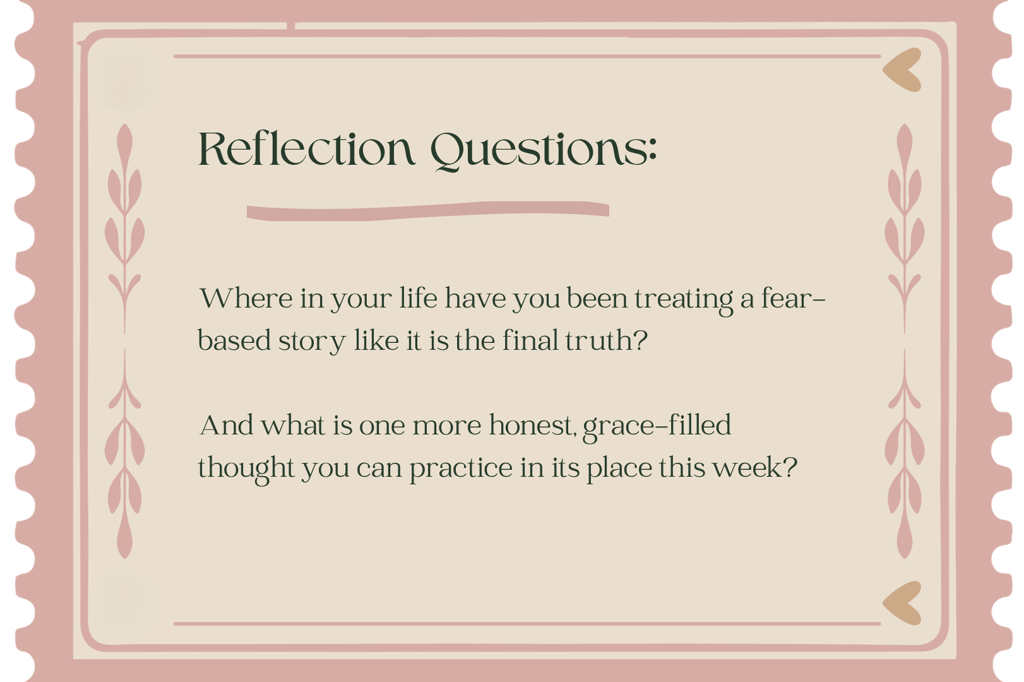
So maybe the question is not always, “Why am I not succeeding yet?” Maybe sometimes the question is, “What story am I telling myself about what this season means?”
Because the story matters.
If I believe, “I am never going to succeed,” I engage from defeat. I move with hesitation. I start looking for evidence that confirms what I already fear. Every delay becomes proof. Every mistake becomes a verdict. Every quiet season becomes a courtroom, and somehow I am always the one on trial.
But if I can gently reframe that thought into something more truthful, not fake, just more complete, my posture changes.
Instead of “I am never going to succeed,” I might say, “I am discouraged because this has not worked the way I hoped, but I am still learning how to move differently.”
Instead of “I always fail,” I might say, “I have patterns that need attention, but patterns can be changed one honest step at a time.”
Instead of “Everyone else is becoming an adult and I am just pretending,” I might say, “I am comparing their visible fruit to my hidden formation, and that is not a fair measurement.”
Until Next Time,
Tori
The Comparison Trap
That last one is personal.
Comparison has a way of making us feel like we are playing dress-up in a life everyone else seems to understand. You look at someone else’s conviction, rhythm, confidence, or consistency, and suddenly your own process feels childish. Like they are really living and you are still trying to figure out the instruction manual. Except the instruction manual is missing, the box is torn, and somehow there are extra screws.
But comparison rarely tells the whole truth. It shows us someone else’s visible chapter and asks us to judge our entire manuscript by it. We do not know the private wrestle behind their steadiness. We do not know what they had to learn, lose, confront, practice, or surrender to become who we are now observing.
And even if they are ahead in one area, that does not make us behind in the eyes of God.
It makes us human.
When Christ’s Strength Meets Your Weakness
This is where Philippians 4:13 becomes more than a phrase we put on mugs, bookmarks, and the occasional gym shirt. “I can do all things through Christ who strengthens me” does not mean every outcome will happen exactly the way I imagined. It does not mean I will never feel weak, afraid, discouraged, or tired.
Maybe it means I do not have to rely on my own emotional certainty to take the next step.


Maybe Christ’s strength meets me right where my confidence runs out.
That feels more honest to me.
Because some days, I do not feel like I can do all things. Some days, I barely feel like I can do the next thing. But maybe that is where the verse becomes lived instead of recited. Not in the loud, confident moment when everything is working, but in the quiet moment when I am discouraged and still choose one faithful step.
So today, I am not asking us to pretend we are positive.
I am asking us to become more aware of the thoughts that are leading us.
Because how we think about a thing affects how we enter it. And how we enter it affects how we engage. And how we engage often shapes what we are able to sustain.
A negative thought does not make us bad. A discouraged thought does not mean we lack faith. But an unchecked thought can become a steering wheel. And if fear is driving, we should not be surprised when we keep ending up parked in the same place.




Keep It Simple This Week
So maybe the work this week is simple.
Not easy. Simple.
Catch the thought.
Question the story.
Look for the fuller truth.
Take one small step from that place.
And if all you can do today is whisper, “God, help me see this differently,” that counts too.
Sometimes the reframe begins there.
A Little Support for the Journey
If something in this stirred you, if you are tired of letting discouragement quietly narrate your whole story, please know you do not have to do this reframing work alone or from memory. I created the Resisting Discouragement Journal for seasons exactly like this one: a gentle, guided space to catch the thought, question the story, look for the fuller truth, and take one small faithful step at a time, with scripture, reflection, and prayer to walk beside you.
It is not a quick fix, and it will not pretend the wilderness is already behind you. It is simply structured companionship for the days when your mind gives up before you do, something to put in your hands when the encouragement needs to last longer than a single moment.