When You Keep Losing Your Way: A Faith- Filled Return to the Path
Tori Thomas
1/30/20269 min read


There’s a kind of exhaustion that doesn’t come from work.
It comes from trying to be the version of yourself you believe you “should” be… and realizing you keep missing her.
You’re not trying to be a bad person.
You’re not out here plotting evil like a cartoon villain.
You actually want to do right.
But somehow you still end up off course—again.
You get back on track, feel steady for a moment, and then life happens:
People stress you out.
Your emotions spike.
Your patience runs out.
Your peace feels threatened.
And suddenly you’re back in that familiar place—annoyed with yourself, questioning if God is tired of you, wondering if you even matter.
If any of that sounds like you, I want you to know something upfront:
Struggling to stay aligned is not the same as being rejected.
And drifting doesn’t mean you’re doomed.
Sometimes it just means you’re human in a wilderness season—learning how to return.
The Fear We Don’t Say Out Loud
A lot of us have this quiet fear buried under our faith:
“What if I mess up too many times?”
“What if I keep making the same mistakes?”
“What if God is tired of hearing from me?”
And then we read stories like Saul’s in 1 Samuel and feel that fear stand up in our chest like, See? This is what happens. One wrong move and it’s over.
At least, for me that’s how I initially felt about Saul’s story without seeing the big picture.
Reading Saul’s story for the first time, or reading it again while you’re already carrying your own fears, can feel like whiplash.
Saul wasn’t some random man who stumbled into leadership.
He was Chosen.
Anointed.
Given an assignment by God.
And yet, toward the end of his reign, Scripture says that God regretted making him king.
That line can mess with you if you’re honest.
Because it immediately raises a question a lot of us don’t say out loud:




He acts quickly to relieve pressure—especially when people are watching, waiting, or complaining.
He grabs control when waiting feels costly—because trusting God feels too slow when anxiety is loud.
He partially obeys and then reframes it—like “close enough” should count as faithfulness.




Here’s another thing people don’t always understand unless they’ve lived it:
You can genuinely want community… and still feel drained by people.
You can want to reach out… and then immediately want to be left alone.
You can want to help… but also fear being pulled into someone else’s chaos until your peace is gone and you don’t recognize yourself anymore.
And sometimes you’re not even selfish—you’re just tired of being the strong one.


And the moment someone cuts you off in traffic, you’re cussing like you paid for premium access to profanity.
So you start thinking:
“See? I’m not her.”
“I’ll never be her.”
“I’m not worthy of leadership.”
“I’m not worthy of responsibility.”
“God must be tired of this.”
But here’s the truth:


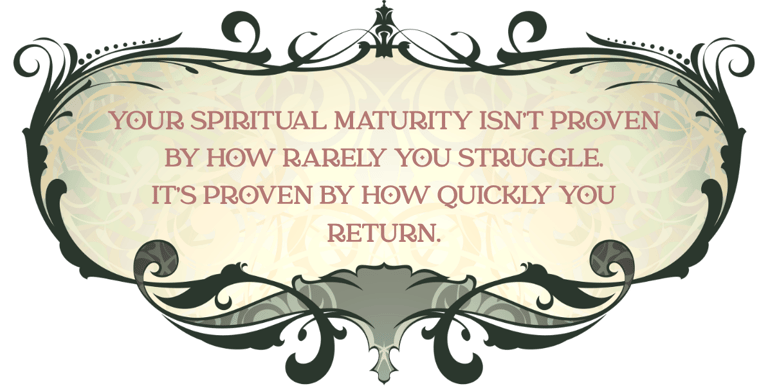






If you’re in a wilderness season right now—tired, uncertain, trying to find your footing again—let this be your reminder: You Were Never Meant To Wander Forever.
I created the Wilderness Journey’s End journals to help you return to the path with faith, clarity, and small actionable steps. You can explore the journals in the shop and choose the one that matches what you’re carrying right now.
Until Next Time,
Tori
You’re not trying to become a perfect person overnight. You’re learning how to return—consistently, gently, and on purpose.
Sometimes we drift because we’re depleted—not because we don’t love God.
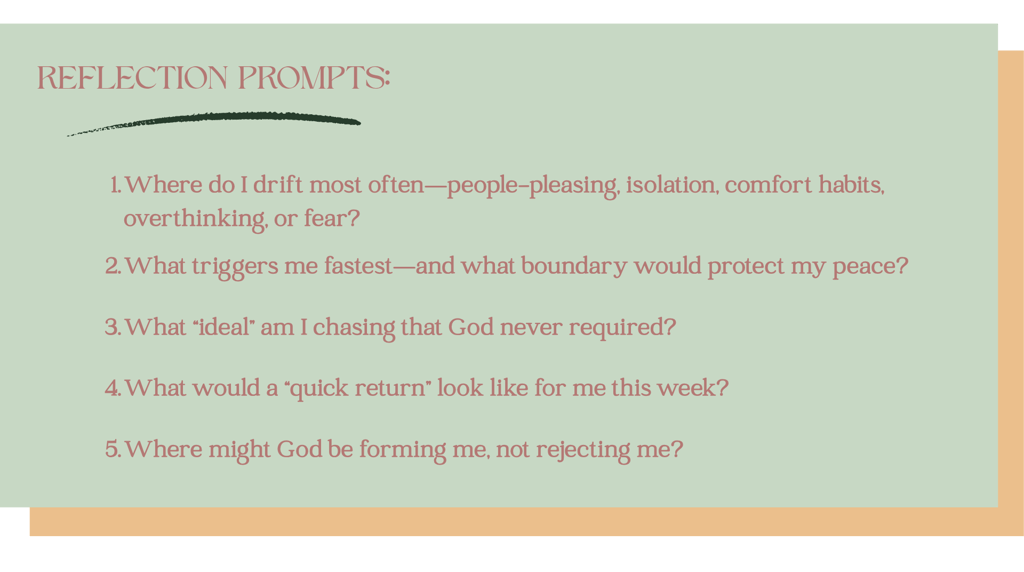
Here are a few journal prompts to process through that will help you identify what’s actually pulling you off course (pressure, exhaustion, fear, people-pleasing) and name one small step back to center.
Maybe you’re not the woman you think you should be—yet.
But what if the woman you’re becoming isn’t built through never struggling…
…what if she’s built through the sacred, stubborn practice of returning?
One prayer.
One boundary.
One pause.
One step.
And then another.
God isn’t looking for perfection. He’s looking for return.
Repentance isn’t groveling—it’s turning back while you still can.
If you didn’t matter, you wouldn’t feel this tug to be close to Him.
This grief you feel about drifting is not proof you’re hopeless.
It’s proof you still care.
And the God who invites return is not sitting in heaven rolling His eyes at you.
He is the God who says, “Come back.”
Not once.
Not twice.
As many times as you’re willing to return.
Because the goal isn’t to never enter the Wilderness.
The goal is to learn that the Wilderness isn’t where you’re abandoned.
It’s where you’re being formed.
Because the path doesn’t belong to the person who never slips.
It belongs to the person who says:
“Okay. I drifted. I got triggered. I lost my peace.
But I’m coming back.”
That is not weakness.
That is formation.
That is what “becoming” looks like in real life.
Not perfection—responsiveness.
A Gentle Practice for the Woman Who Keeps Drifting
If you’re tired of starting over, try this instead:
1) The Daily Return (5 minutes)
At any point in your day, pray:
“God, where am I off course?”
“What’s the next right step?”
“Give me the strength to do that one thing.”
Not ten steps.
Not a full life overhaul.
Just the next step.
2) Community with boundaries (one tiny step)
Pick one:
text one safe person: “Can we do a 15-minute catch-up this week?”
attend one thing where you can leave early
schedule a coffee with a hard stop time
You can be in community and protect your peace.
Community doesn’t require full access to you.
3) Kindness with Boundaries
You can love people without carrying them.
Before you say yes, ask:
Do I have capacity?
Is this mine to carry?
What boundary do I need to name upfront?
Sometimes “being kind” looks like:
“I can talk for 10 minutes, but I can’t troubleshoot today.”
That’s not mean.
That’s wisdom.
That’s knowing your limits, where you currently are, and what you personally can shoulder.
4) The Two-Second Pause
When you feel yourself about to snap—especially when triggered—pause and say:
“Lord, help me choose my next response.”
Two seconds is small.
But two seconds can keep you from becoming someone you don’t recognize.
If You’re Wondering If You Matter to God
Let me speak to the tender fear beneath all of this:
“I wonder if God listens to me.” “If I mess up, will I still be loved? Will I still matter? Will God still want me?”
And if you’re wondering which one you’ve been listening to… ask yourself this:
Does this voice make me want to repent and return?
Or does it make me want to withdraw and disappear?
God corrects us—yes.
But He corrects to restore, not to erase.
You Don’t Need a Perfect Track Record—You Need a Practice of Returning
This is the reframe I wish more of us had:
That ideal isn’t always holiness. Sometimes it’s perfectionism wearing a church dress.
God is not asking you to become a flawless woman overnight.
He’s shaping you into a surrendered woman over time.
And those are not the same thing.
The Difference Between Conviction and Condemnation
If you’ve been stuck in cycles, this part can change everything.
Conviction pulls you toward God:
“Come back. Let’s realign. You’re not alone.”
Condemnation pushes you away from God:
“Hide. You’re a failure. Don’t bother praying. You’ve worn Him out.”
One voice produces humility and return.
The other produces hiding and isolation.
Tired of being the listener.
Tired of being the fixer.
Tired of being the one who “handles it.”
So isolation starts to feel like safety.
But then isolation turns into loneliness.
And loneliness turns into shame.
And shame turns into, "I don’t even want to try anymore".
And now you’re not only exhausted…
You’re stuck.
The Real Problem Might Not Be Your Character—It Might Be Your “Ideal”
This is where a lot of self-sabotage begins.
Not because you don’t love God.
But because you carry an “idealized version” of yourself like a measuring stick—and you keep using it to beat your own spirit.
You have this picture in your mind of who you’re supposed to be:
Always patient
Always gracious
Always emotionally steady
Always kind
Always wise
Always unbothered
The pattern is not: fail once = damned forever.
The pattern is: God responds to the posture of the heart—especially after failure.
Consequences are real, but condemnation isn’t the same thing.
Saul loses the kingdom—his role, his assignment.
That doesn’t automatically equal: “his soul is damned and his life meant nothing.”
Saul’s tragedy wasn’t that one human mistake erased all the good.
It was that Saul kept choosing a way of being king that wouldn’t stay submitted to God—especially when submission felt inconvenient, costly, or humiliating.
Certain assignments require ongoing surrender. Saul wanted the benefits of God’s favor without the vulnerability of trusting God under pressure.
Saul’s story warns about something many of us do when we’re scared:
We Start out obeying God… until obedience costs us comfort, speed, or approval.
And then we “sacrifice” instead:
We offer explanations.
We offer spiritual-looking substitutes.
We offer “good intentions.”
We offer partial obedience dressed up as wisdom.
Saul teaches us that good intentions can’t replace surrendered trust.
But here’s the other side of it: a lot of us are just tired. Triggered. Overwhelmed. Inconsistent.
We want to obey God, but we keep losing the path when it gets hard.
That’s not rebellion.
That’s a discipleship problem.
Which means there’s hope, because disciples can grow. And people who drift can return.
When Community Feels Like a Blessing… and a Burden
And when he’s confronted, he protects his image—instead of fully returning with a surrendered heart.
And 1 Samuel 15 is where it becomes clearest.
Saul doesn’t just make a mistake—he tries to redefine obedience.
He wants to hold onto what he wants and hold onto God’s approval.
That’s why Samuel’s words cut so deep:
And if I’m already struggling with my own inconsistency—already aware of how easily I get distracted, how quickly I can drift—then it’s hard not to personalize it:
What if I start with good intentions too… but lose my way along the path?
What if I mean well, but still make choices that slowly pull me off course?
What if one day I look up and realize I’ve wandered farther than I ever intended?
At first glance, Saul’s story can seem like a warning that one wrong move cancels everything.
But keep reading.
When you slow down and look closer, you realize Saul’s downfall wasn’t a single slip.
It was a drift. A trajectory.
Not one moment of weakness, but repeated moments of choosing what relieved pressure over what required trust.